WooCommerce vs Shopify: How to Choose for a Small Store
WooCommerce vs Shopify for a small store: compare cost, transaction fees, ownership, flexibility and effort, and see when Shopify is the better pick.
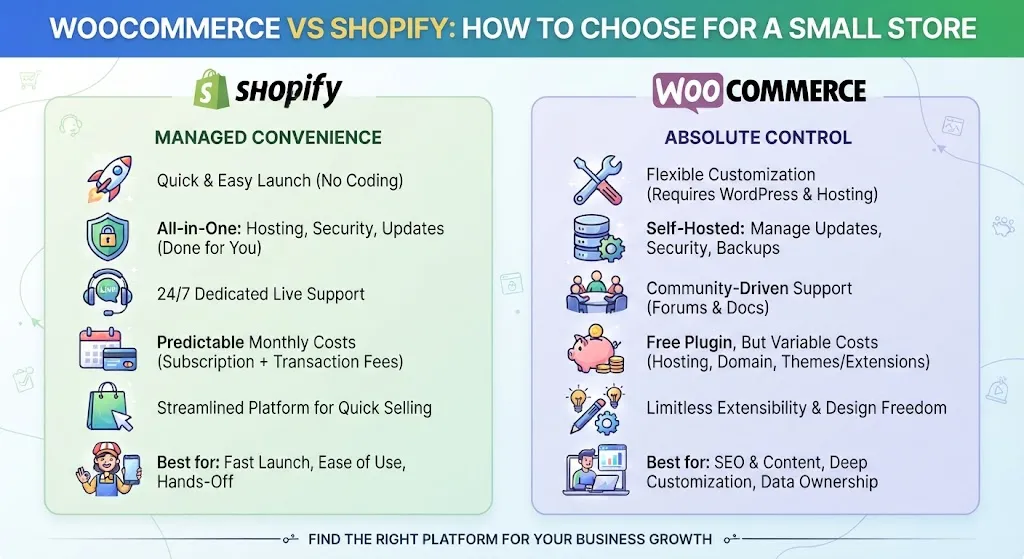
Quick Answer
Choose Shopify if you want a hosted, low-maintenance shop that is quick to launch and you are happy to pay a monthly plan. Choose WooCommerce if you want ownership, flexibility and lower platform costs, and you are comfortable managing hosting, updates and security or paying someone to.
Every small store owner hits the same fork: WooCommerce vs Shopify. Both can run a good shop. The right one depends less on features and more on how much you want to manage, what you can spend each month, and how much control you need.
A note on bias before we start. I build with WordPress and WooCommerce, not Shopify, so I will say plainly where Shopify is the better choice. Pricing below was read from the official pages and is accurate at the time of writing (October 2026). Check the live pages before you decide, because both change.
How they actually differ
Shopify is a hosted service. You pay a plan, and Shopify runs the servers, security patches and checkout for you. Its pricing page says hosting and an SSL certificate are included on every plan, and that you can sell unlimited products.
WooCommerce is a free, open-source plugin that turns a WordPress site into a shop. Its WordPress.org page says the core platform is free and that you keep full ownership of your store's content and data. It also shows over 7 million active installations, so help and developers are easy to find.
The catch is that "free" covers the software, not the running of it. You supply hosting, a domain, a theme, and often paid extensions. You also own the updates, backups and security, which is real work.
What each one costs
Shopify plans
On its pricing page in October 2026, Shopify listed these US dollar prices:
- Basic: a month, or a month on annual billing
- Grow: 5 a month, or a month on annual billing
- Advanced: 9 a month, or 9 a month on annual billing
- Plus: from ,300 a month
It also showed a trial offer of 3 days free, then a month for 3 months. Prices vary by country, and apps from the app store are separate costs.
Transaction fees
This is where owners get surprised. Shopify listed online card rates of 2.9% + 30 cents on Basic, 2.7% + 30 cents on Grow, and 2.5% + 30 cents on Advanced. If you use a third-party payment provider instead of Shopify Payments, its page says a third-party transaction fee may apply: 2% on Basic, 1% on Grow, 0.6% on Advanced and 0.2% on Plus.
With WooCommerce, the platform itself has no monthly subscription. Its own payment option, WooPayments, states there are no setup fees or monthly fees for online payments, and its fees depend on country, payment method and currency. Other gateways set their own rates. Either way, card processing is never free on any platform, so compare the processor rate, not just the platform fee.
Your real WooCommerce budget
Add up hosting, domain, theme, essential extensions (for example bookings, subscriptions or shipping rules), a backup tool, and maintenance. These vary by vendor, so I will not quote numbers here. Our guide to what a WordPress website costs breaks the categories down.
WooCommerce vs Shopify at a glance
| Factor | WooCommerce | Shopify |
|---|---|---|
| Platform cost | Software is free, you pay for hosting and extras | Monthly plan, from (annual) or (monthly) for Basic |
| Hosting and security | You or your developer manage it | Included and managed by Shopify |
| Transaction fees | Set by your chosen payment provider | Card rates by plan, plus extra fee for third-party gateways |
| Ownership of data | Full, exportable, per WordPress.org | Lives on Shopify's platform, so check its export options |
| Flexibility | Very high, anything WordPress can do | High within the app and theme ecosystem |
| Technical comfort needed | Medium to high, or a maintainer | Low to medium |
| Time to launch | Usually slower, more setup choices | Usually faster, fewer decisions |
| Best for | Content-led shops, custom needs, tight long-run costs | Simple catalogs, quick launch, hands-off owners |
When Shopify is the better choice
Be honest about this, because the wrong pick costs months.
- You want to launch fast with no server knowledge. Included hosting removes a whole category of decisions.
- Nobody on your side will manage updates, backups or security, and you do not want to pay someone to.
- Your catalog is simple: physical products, standard shipping, standard checkout.
- You value one company being responsible when something breaks.
- You are testing a product idea and want a low-commitment start.
When WooCommerce is the better choice
- You already run a WordPress site and want the store and content in one place, which helps a lot for content-led selling.
- You need unusual logic: bookings, memberships, custom pricing, complex product options, or unusual checkout steps.
- You want ownership and the freedom to change hosts, themes or developers without being tied to one vendor.
- Your volumes are growing and you want control over payment providers and their rates.
- You have, or will pay for, someone to keep it maintained.
A quick way to decide
By store size: a handful of products and a first launch leans Shopify. A growing catalog with custom needs leans WooCommerce.
By technical comfort: if the word "plugin conflict" makes you tired, lean Shopify or budget for care. If you or your developer are comfortable with WordPress, WooCommerce gives more room.
By budget: Shopify is more predictable month to month. WooCommerce can cost less over time but front-loads setup and needs ongoing care. Plan for that with a proper maintenance plan.
By ownership: if portability matters to you, WooCommerce is the cleaner answer. By flexibility: WooCommerce wins on custom needs, Shopify wins on guided simplicity.
Still comparing WordPress against hosted builders more broadly? See WordPress against hosted builders.
Making WooCommerce sell
If you go the WooCommerce route, the platform is only the start. Speed, trust signals, checkout friction and product pages decide whether visitors buy. Our sales-focused WooCommerce setup article covers how that fits together.
Not sure yet? Get a second opinion
If you are still weighing WooCommerce vs Shopify for your own store, Muhammad Muheet offers a free initial audit of your plan or current site. Work comes with competitive pricing, flexible installments and 4 weeks of post-development support. Message on WhatsApp or book a free initial audit. If Shopify turns out to be the better fit for you, that is a useful answer too.